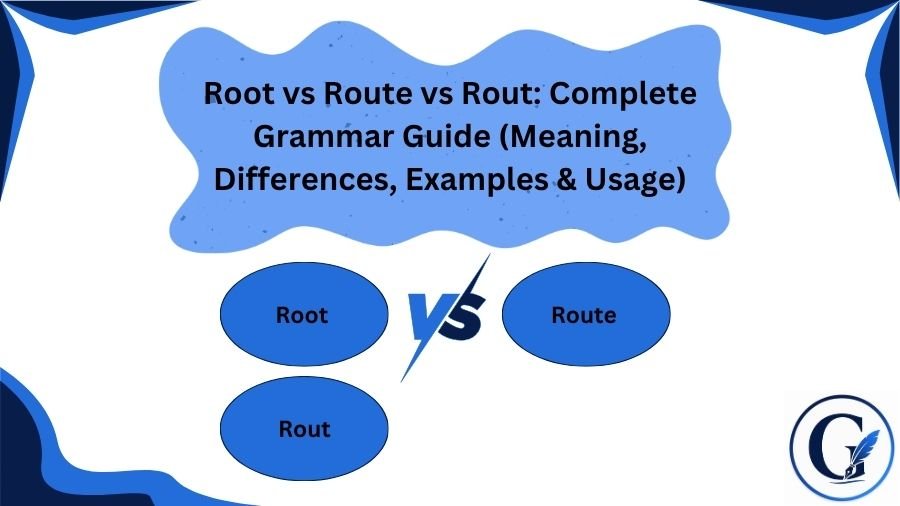
Root vs Route vs Rout: Complete Grammar Guide (Meaning, Differences, Examples & Usage)
English can be confusing, especially when words look or sound almost identical but have completely different meanings. One such tricky trio is “root vs route vs rout.” These words often confuse learners, writers, and even native speakers because they are spelled similarly but used in very different contexts.
For example, “root” can refer to the base of a plant or the origin of something, while “route” is about a path or direction. On the other hand, “rout” is less common in daily conversation but has strong meanings related to defeat or disorder. Mixing them up can completely change the meaning of a sentence and lead to misunderstandings.
In this article, we will break down root vs route vs rout in a simple, clear, and practical way. You will learn their meanings, differences, grammar rules, real-life examples, common mistakes, and usage in different contexts. By the end, you will never confuse these words again and will confidently use them in writing and speech. 😊
Quick Answer: Root vs Route vs Rout

- Root: The base or origin of something (e.g., plant root, cause of a problem).
- Route: A path or way taken to reach a destination.
- Rout: A complete defeat or chaotic disorder in a situation.
👉 In short:
- Root = origin/base
- Route = path/direction
- Rout = defeat/disorder
Understanding the Basics (Root vs Route vs Rout)
These three words are homophones or near-homophones depending on accent, meaning they can sound similar but differ in spelling and meaning.
Key Differences Explained
- Root → Focuses on origin or foundation.
- Route → Focuses on movement or travel path.
- Rout → Focuses on destruction, defeat, or chaos.
Comparison Table
| Word | Type | Meaning | Example Sentence | Correct/Incorrect Usage |
|---|---|---|---|---|
| Root | Noun/Verb | Base or origin of something | The root of the tree is deep. | Correct |
| Route | Noun | Path or direction of travel | We changed our route to avoid traffic. | Correct |
| Rout | Noun/Verb | A complete defeat or chaos | The team suffered a rout in the final. | Correct |
Also Read This: Whole Day vs All Day
Correct Meanings & Uses
1. ROOT – Origin, Base, or Foundation 🌱
The word root refers to the base or starting point of something. It is commonly used in science, mathematics, language, and even emotions.
Examples:
- The root of a tree absorbs water and nutrients.
- We must find the root of the problem.
- Latin is the root of many English words.
Sentence Breakdown:
“The root of the issue lies in poor communication.”
- Root = cause/origin
- Issue = problem
- Lies = exists
Test Tip:
👉 If you can replace the word with “origin” or “cause,” then root is correct.
2. ROUTE – Path or Direction 🛣️
The word route refers to a path or way taken to reach a destination. It is commonly used in travel, navigation, and logistics.
Examples:
- This is the fastest route to the airport.
- The delivery truck changed its route due to traffic.
- We planned a scenic route for our road trip.
Sentence Breakdown:
“We took a different route home.”
- Route = path
- Home = destination
Test Tip:
👉 If you can replace it with “path” or “way,” then route is correct.
3. ROUT – Defeat or Disorder ⚔️
The word rout is less commonly used but very important in formal English. It means a complete defeat or chaotic situation.
Examples:
- The army faced a total rout in battle.
- The football match ended in a rout.
- The sudden panic caused a rout in the crowd.
Sentence Breakdown:
“The team was in rout after the final goal.”
- Rout = complete defeat
- Team = subject
Test Tip:
👉 If it means “defeat or chaos,” then rout is correct.
Case Study Section 📘
Workplace Example:
An email from a manager:
❌ Incorrect:
“We need to change our root for delivery due to traffic.”
✔ Correct:
“We need to change our route for delivery due to traffic.”
Explanation:
- “Route” is correct because it refers to a delivery path.
- “Root” would incorrectly suggest origin or cause.
Grammar Rules Explanation 📚
According to standard dictionaries like Merriam-Webster, each word has a completely different origin:
- Root comes from Old English “rot,” meaning base or origin.
- Route comes from French “route,” meaning road.
- Rout comes from Old French “route,” meaning broken troop or defeat.
👉 These are not interchangeable because they belong to different meanings and contexts.
Common Mistakes Section ⚠️
Why People Confuse Them
- Similar spelling and pronunciation
- Fast typing without checking
- Autocorrect errors
- Lack of vocabulary clarity
Similar Confusing Words Table
| Word Pair | Common Mistake Example | Correct Usage |
|---|---|---|
| Its / It’s | Its raining today ❌ | It’s raining ✔ |
| Your / You’re | Your amazing ❌ | You’re amazing ✔ |
| Root / Route / Rout | Wrong mix in sentences ❌ | Context decides ✔ |
Usage in Different Contexts
1. Everyday Conversation 🗣️
- “What is the route to your house?”
- “The root of my headache is stress.”
- “The game ended in a rout.”
2. Professional Writing 💼
- Use route in logistics and planning.
- Use root in analysis or reporting.
- Use rout in military or performance analysis.
3. Creative Writing ✍️
- “The roots of fear grew deeper in his mind.”
- “They chose a hidden route through the forest.”
- “The battle ended in a brutal rout.”
4. Social Media/Texting 📱
- “New route to work is better!”
- “Finding the root cause of this issue 😂”
- “That match was a total rout!”
Why It Matters (Important)
Using the correct word improves:
- Clarity in communication
- Professional writing quality
- Academic accuracy
- Digital communication effectiveness
“Precision in language builds trust in communication.”
Misusing these words can completely change meaning and make writing confusing or unprofessional.
Special Exception
There are no major exceptions where these words overlap in meaning. However:
- “Route” can sometimes be pronounced like “root” in some accents.
- Context always determines meaning.
Quick Recap Checklist ✔
| Question | If Yes → Use |
|---|---|
| Is it about origin or cause? | Root |
| Is it about a path or direction? | Route |
| Is it about defeat or chaos? | Rout |
Practice Examples:
- The ___ of the problem is unknown.
- We changed our ___ due to traffic.
- The army suffered a ___.
FAQs (Frequently Asked Questions)
1. What is the main difference between root, route, and rout?
Root means origin, route means path, and rout means defeat or chaos.
2. Is route and root pronounced the same?
In some accents, they may sound similar, but they have different meanings and spellings.
3. Can root mean direction?
No, root never means direction. It refers to origin or base.
4. Is rout commonly used in daily English?
No, rout is more formal and often used in sports, military, or serious contexts.
5. How can I remember the difference easily?
Think:
- Root = plant base 🌱
- Route = road 🛣️
- Rout = defeat ⚔️
6. What happens if I mix them up?
It can change the meaning of your sentence and confuse the reader.
Conclusion
Understanding the difference between root vs route vs rout is essential for clear and accurate English communication. Although these words look and sound similar, they carry completely different meanings that should never be mixed.
Root refers to the origin or base of something, route refers to a path or direction, and rout refers to a complete defeat or disorder. By learning their definitions, examples, and usage patterns, you can avoid common mistakes and improve your grammar skills significantly.
Whether you are writing emails, academic essays, or social media posts, using the correct word ensures clarity and professionalism. Always focus on context before choosing the word.
With practice and awareness, these confusing words will become easy to use correctly. Keep this guide in mind, and you’ll never confuse root, route, and rout again. 😊

Hi, I’m James Anderson, an educator passionate about teaching grammar and writing skills. I aim to simplify complex topics and help learners build strong communication abilities.