Awaiting vs Waiting: Complete Guide to Meaning, Difference, and Proper Usage
Have you ever paused while writing a sentence and wondered whether to use awaiting vs waiting? You’re not alone. The confusion around awaiting vs waiting is very common among English learners, writers, and professionals because both words look similar and describe the idea of delay or expectation. However, they are not always interchangeable, and using the wrong one can change the tone or correctness of your sentence.
The confusion usually comes from how English handles verbs in different structures and levels of formality. Many people think “awaiting” is simply a more formal version of “waiting,” but the real difference is deeper and based on grammar rules.
In this article on awaiting vs waiting, we will clearly break down meanings, rules, examples, and common mistakes so you can confidently use both words in real-life writing situations. ✨
Quick Answer: Awaiting vs Waiting
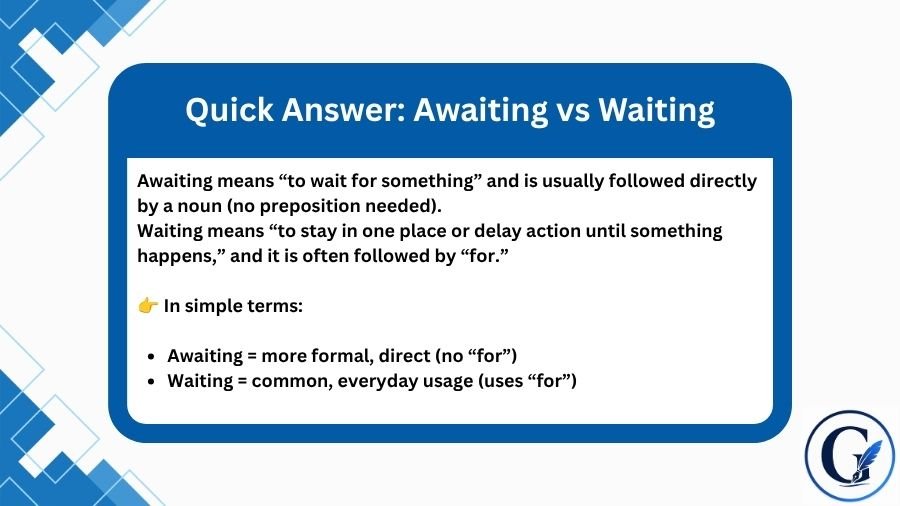
Awaiting means “to wait for something” and is usually followed directly by a noun (no preposition needed).
Waiting means “to stay in one place or delay action until something happens,” and it is often followed by “for.”
👉 In simple terms:
- Awaiting = more formal, direct (no “for”)
- Waiting = common, everyday usage (uses “for”)
Understanding the Basics: Awaiting vs Waiting
Let’s break down the core difference clearly.
1. Form and Structure
| Form | Type | Meaning | Example | Correct/Incorrect |
|---|---|---|---|---|
| Awaiting | Verb form | To wait for something | I am awaiting your reply. | Correct |
| Waiting | Verb form | To stay until something happens | I am waiting for your reply. | Correct |
| Waiting on | Phrase | Informal dependency | I am waiting on your reply. | Informal |
2. Key Structural Difference
- Awaiting → NO preposition needed
- Waiting → usually needs “for”
Examples:
- I am awaiting your response. ✔️
- I am waiting for your response. ✔️
- I am waiting your response. ❌ (incorrect grammar)
Also Read This: Postfix vs Suffix
Correct Meanings & Uses
1. Meaning of “Awaiting”
“Awaiting” is a transitive verb, meaning it directly takes an object without a preposition.
Examples:
- We are awaiting approval from management.
- The team is awaiting results.
- She is awaiting her interview call.
Sentence Breakdown:
- Subject: We
- Verb: awaiting
- Object: approval
👉 No extra word like “for” is needed.
💡 Test Tip:
If you can directly place a noun after it without “for,” use awaiting.
2. Meaning of “Waiting”
“Waiting” is more flexible and commonly used in spoken English.
Examples:
- I am waiting for the bus.
- They are waiting for dinner.
- He is waiting for his friend.
Sentence Breakdown:
- Subject: I
- Verb: waiting
- Preposition: for
- Object: bus
💡 Test Tip:
If you naturally say “for something,” use waiting.
Case Study Section 📩
Workplace Email Example
Incorrect:
Dear Manager, I am waiting approval for the project.
Correct:
Dear Manager, I am awaiting approval for the project. ✔️
OR
I am waiting for approval for the project. ✔️
Analysis:
- “Awaiting approval” sounds formal and professional.
- “Waiting for approval” is neutral and commonly used.
👉 In corporate communication, awaiting often sounds more polished.
Grammar Rules Explanation 📘
According to standard grammar references like Merriam-Webster and Oxford English Dictionary:
- “Await” is a transitive verb, meaning it does NOT require a preposition.
- “Wait” is typically an intransitive verb, often requiring “for.”
Why this matters:
- Await = direct object
- Wait = needs connection word (for)
This is the main structural reason behind the difference.
Common Mistakes Section ❌
Why people confuse them:
- Fast typing ⌨️
- Autocorrect interference 📱
- Lack of grammar awareness 📚
- Influence of spoken English 🗣️
Common Confusions Table
| Incorrect Form | Correct Form | Reason |
|---|---|---|
| Waiting your reply | Waiting for your reply | Missing “for” |
| Awaiting for result | Awaiting result | “For” not needed |
| I am wait reply | I am waiting for reply | Wrong verb form |
| Awaiting for approval | Awaiting approval | Preposition error |
Usage in Different Contexts
1. Everyday Conversation 🗣️
- I’m waiting for my friend.
- I’m awaiting his call.
2. Professional Writing 💼
- We are awaiting confirmation.
- Please wait for further instructions.
3. Creative Writing ✍️
- She waited under the rain.
- He was awaiting destiny’s answer.
4. Social Media/Texting 📱
- Waiting for weekend vibes!
- Awaiting results 😬
Why It Matters (Important Section) ⭐
Using awaiting vs waiting correctly improves:
- Professional communication
- Grammar accuracy
- Clarity in writing
- First impressions in emails and resumes
“Clear language creates clear thinking.”
When your writing is precise, people trust your message more.
Special Exception Section ⚠️
In modern English usage:
- “Waiting on” is often used informally (especially in American English).
- Example: I’m waiting on my order.
However:
- It is less formal than “waiting for”
- Not recommended in professional writing
Quick Recap Checklist ✅
| Question | If Yes → Use |
|---|---|
| Do you need “for”? | Waiting |
| Is it formal writing? | Awaiting |
| Is a noun directly after verb? | Awaiting |
| Is it casual speech? | Waiting |
Practice Examples:
- I am ___ your reply.
→ Awaiting / Waiting for - She is ___ results.
→ Awaiting / Waiting for - We are ___ the bus.
→ Waiting for
FAQs: Awaiting vs Waiting
1. What is the main difference between awaiting and waiting?
“Awaiting” does not use “for” and is more formal, while “waiting” usually requires “for” and is more common in everyday English.
2. Can I say “waiting your reply”?
No, it is incorrect. You must say “waiting for your reply.”
3. Is “awaiting” more formal than “waiting”?
Yes, “awaiting” is generally used in formal or professional writing.
4. Can “awaiting” and “waiting” be used interchangeably?
In meaning, yes. But grammatically, their structure is different.
5. Which is better for emails?
“Awaiting your response” is more professional and widely used in formal emails.
6. Is “waiting on” correct?
Yes, but it is informal and mostly used in spoken English.
Conclusion
Understanding the difference between awaiting vs waiting is a small but powerful step toward mastering English grammar. While both words express the idea of delay or expectation, their usage depends on structure and formality. “Awaiting” is more direct, formal, and does not require a preposition. On the other hand, “waiting” is more flexible and commonly used in everyday communication with “for.”
Choosing the right word improves clarity, professionalism, and confidence in writing. Whether you are drafting emails, preparing academic work, or simply chatting online, using these words correctly helps you sound more natural and accurate.
So next time you pause while writing, remember this simple rule:
👉 If it’s direct, use “awaiting.”
👉 If it needs “for,” use “waiting.”
Mastering this difference will instantly refine your English and make your communication sharper, clearer, and more effective. ✨

Hi, I’m Sarah Williams, a content writer who loves creating simple and clear educational articles. My goal is to help learners improve their grammar and writing confidence.