Flesh Out or Flush Out: Meaning, Difference, and Correct Usage (Complete Guide)
Have you ever been writing an email, essay, or report and suddenly stopped because you weren’t sure whether to say “flesh out or flush out”? 🤔 You’re not alone. The confusion between flesh out or flush out is extremely common because both phrases sound similar but have completely different meanings, and using the wrong one can completely change your message.
Many English learners, professionals, and even native speakers mix up these expressions because they are homophones. As a result, mistakes often appear in business writing, academic work, emails, and even social media posts.
In this article, we will clearly explain the difference between flesh out or flush out, when to use each one, and how to avoid common grammar mistakes. You will also get real-life examples, tables, usage rules, and a complete FAQ section to make everything crystal clear.
By the end, you’ll never confuse these two phrases again—and your writing will become more accurate and professional. ✍️
Quick Answer: Flesh Out or Flush Out
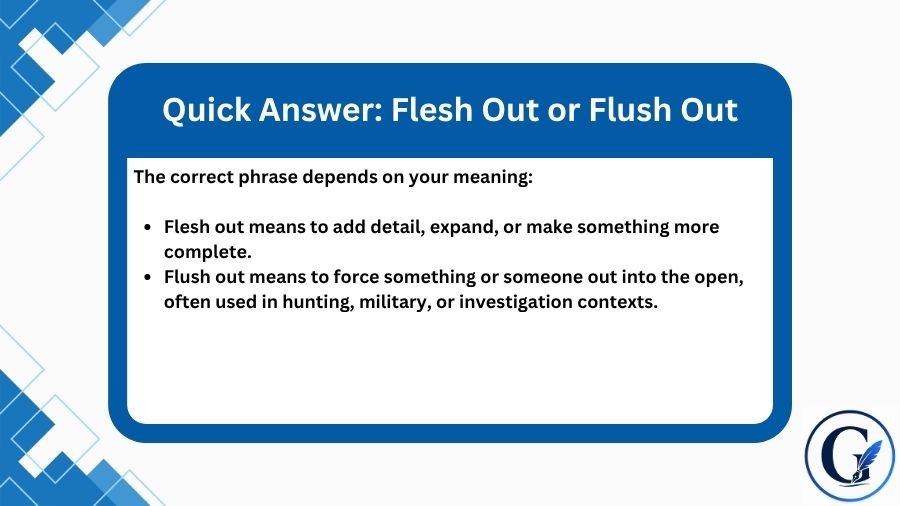
The correct phrase depends on your meaning:
- Flesh out means to add detail, expand, or make something more complete.
- Flush out means to force something or someone out into the open, often used in hunting, military, or investigation contexts.
👉 Simply put:
- Use flesh out when you are expanding ideas.
- Use flush out when you are removing or revealing something hidden.
Understanding the Basics: Flesh Out vs Flush Out
To fully understand the difference, let’s break both phrases down in simple terms.
🔹 What Does “Flesh Out” Mean?
“Flesh out” means to add more information, depth, or detail to something that is incomplete.
It is commonly used in:
- Writing
- Planning
- Ideas
- Business strategies
- Story development
👉 Think of it like adding “flesh” to bones—making something fuller and more complete.
Example:
- We need to flesh out the project proposal before submitting it.
🔹 What Does “Flush Out” Mean?
“Flush out” means to force something hidden into the open or to remove it completely.
It is commonly used in:
- Military operations
- Police investigations
- Hunting
- Pest control
- Security contexts
👉 Think of flushing something out of hiding.
Example:
- The police used a search operation to flush out the suspects.
Also Read This: Reschedule To vs Reschedule For
Comparison Table: Flesh Out vs Flush Out
| Feature | Flesh Out 🧠 | Flush Out 🚨 |
|---|---|---|
| Form | Phrase verb | Phrase verb |
| Type | Expansion meaning | Removal/revelation meaning |
| Meaning | To add detail or expand | To force out or expose |
| Usage context | Writing, ideas, planning | Security, hunting, investigation |
| Example | Flesh out the story idea | Flush out the criminals |
| Correct usage | Expanding content | Removing hidden elements |
| Common mistake | Confused with “flush out” | Confused with “flesh out” |
Correct Meanings & Uses
🧠 1. Flesh Out – Add Detail or Expand
When you “flesh out” something, you are improving or expanding it.
✔ Example 1:
- The writer needs to flesh out the character background.
👉 Breakdown:
- “Writer” = subject
- “needs to” = necessity
- “flesh out” = expand
- “character background” = object
✔ Example 2:
- We should flesh out the marketing strategy before launch.
🧪 Test Tip:
If you can replace it with “expand” or “add detail,” then flesh out is correct.
🚨 2. Flush Out – Force Into the Open
When you “flush out” something, you are making something hidden come out.
✔ Example 1:
- The army tried to flush out the enemy from the forest.
✔ Example 2:
- The report helped flush out errors in the system.
🧪 Test Tip:
If you can replace it with “force out” or “reveal,” then flush out is correct.
Case Study Section: Real-Life Usage
💼 Workplace Example
Imagine you are working in a marketing team:
Incorrect usage:
- We need to flush out the campaign idea. ❌
Correct usage:
- We need to flesh out the campaign idea. ✔
👉 Why? Because you are adding details, not removing anything.
🕵️ Investigation Example
A police team is searching for a suspect:
Correct usage:
- The investigation helped flush out the suspect hiding in the building. ✔
👉 Why? Because the suspect is being forced out into the open.
Grammar Rules Explanation
According to standard English dictionaries such as Merriam-Webster, these two phrases are distinct idiomatic expressions:
- Flesh out = to make something more complete by adding details
- Flush out = to drive out of hiding or exposure
Why confusion happens:
- They sound similar
- Both use “out”
- Fast writing leads to spelling errors
- Auto-correct often fails to distinguish them
👉 Important rule:
These phrases are not interchangeable. Changing one word changes the meaning completely.
Common Mistakes Section
❌ Why People Get Confused
Most mistakes happen due to:
- ⚡ Fast typing without checking
- 📱 Autocorrect interference
- 📚 Lack of grammar knowledge
- 🎧 Similar pronunciation
📊 Similar Grammar Confusions Table
| Incorrect Pair | Correct Understanding |
|---|---|
| Flesh out / Flush out | Expand vs Reveal |
| Its / It’s | Possession vs Contraction |
| Your / You’re | Possessive vs You are |
| There / Their / They’re | Location vs Possession vs Contraction |
| Affect / Effect | Verb vs Noun |
Usage in Different Contexts
💬 Everyday Conversation
- I need to flesh out my travel plans.
💼 Professional Writing
- The team will flesh out the report before submission.
🎨 Creative Writing
- The author fleshed out the story with emotional depth.
📱 Social Media/Texting
- Let’s flesh out this idea later 👍
Why It Matters (Important Section)
Using the correct phrase improves:
- ✔ Clarity in communication
- ✔ Professional writing quality
- ✔ Academic accuracy
- ✔ Business credibility
As communication expert George Bernard Shaw once implied in his writing philosophy:
“The single biggest problem in communication is the illusion that it has taken place.”
Using “flesh out” vs “flush out” correctly ensures your message is understood exactly as intended.
Special Exception Section
There are no brand-specific or grammatical exceptions for these phrases. However:
- “Flush out” is more common in military, law enforcement, and technical reports.
- “Flesh out” is dominant in academic, business, and creative writing.
Quick Recap Checklist
| Question | If Yes → Use |
|---|---|
| Are you adding detail? | Flesh out |
| Are you exposing something hidden? | Flush out |
📝 Practice Examples
- We need to ___ the idea before pitching it. → Flesh out
- The police tried to ___ the suspects. → Flush out
- The writer will ___ the story later. → Flesh out
FAQs (Frequently Asked Questions)
1. What is the main difference between flesh out and flush out?
“Flesh out” means to add detail, while “flush out” means to force something into the open.
2. Can flesh out and flush out be used interchangeably?
No. They have completely different meanings and cannot be swapped.
3. Is it correct to say “flush out ideas”?
No. The correct phrase is “flesh out ideas.”
4. When should I use flush out?
Use it when talking about revealing, removing, or forcing something hidden out.
5. Is flesh out formal or informal?
It is commonly used in both formal and informal writing, especially in professional and academic contexts.
6. Why do people confuse these words?
Because they sound similar and are often misheard or mistyped.
Conclusion
The confusion between flesh out and flush out is very common, but the difference is actually simple once you understand it. One is about adding detail and expansion, while the other is about removal or exposure.
Remember this easy rule:
- Flesh out = build and expand 🧠
- Flush out = reveal or force out 🚨
Mastering this small but important grammar distinction can significantly improve your writing clarity, professionalism, and communication skills. Whether you’re writing emails, reports, stories, or social media posts, using the correct phrase ensures your message is always understood correctly.
So next time you pause while writing—ask yourself: Am I adding detail, or exposing something hidden? The answer will guide you to the right phrase every time. ✍️

Hi, I’m Michael Brown, a content editor focused on improving writing quality. I help refine grammar, structure, and clarity to make content more effective.