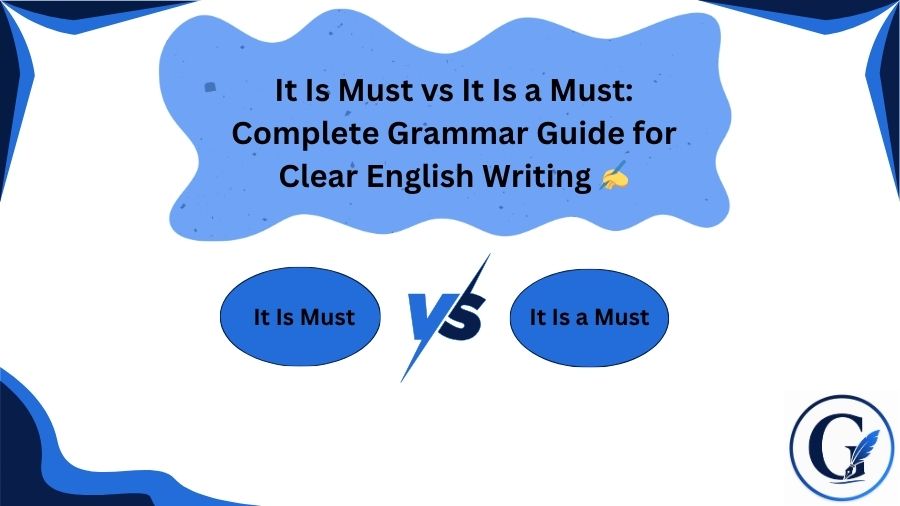
It Is Must vs It Is a Must: Complete Grammar Guide for Clear English Writing ✍️
The confusion between “it is must vs it is a must” is very common in English grammar, especially among learners, writers, and even professionals who want to sound correct in emails, essays, and social media posts. At first glance, both phrases look almost the same, but only one follows proper English grammar rules.
The phrase “it is must vs it is a must” creates confusion because English requires specific structures when using nouns after linking verbs like “is.” A small missing word like “a” can make a sentence sound incorrect or incomplete.
In this article, we will clearly explain the difference between these two forms, show which one is correct, and help you understand how to use it confidently in real-life writing. By the end, you will never confuse these two expressions again. 📘
Quick Answer: It Is Must vs It Is a Must

The correct phrase is “It is a must.”
The phrase “it is must” is grammatically incorrect in standard English because “must” needs an article (“a”) when used as a noun. In this structure, “a must” means something that is necessary or essential.
✔ Correct: It is a must
❌ Incorrect: It is must
Example:
- Learning grammar is a must for good writing skills.
Understanding the Basics: It Is Must vs It Is a Must
To understand this difference clearly, we need to break it down into grammar structure and word usage.
What Does “Must” Mean?
The word “must” is mainly used as:
- A modal verb (e.g., You must go)
- A noun (informal usage: something necessary)
When used as a noun, it always requires an article like “a”.
Why “It Is Must” Is Incorrect
In English grammar, nouns cannot usually stand alone after “is” without an article or determiner unless they are uncountable in a specific context.
Since “must” is being used as a noun meaning “a necessity,” it requires:
👉 Article + noun = “a must”
So, saying:
- ❌ It is must (missing article = incorrect)
Why “It Is a Must” Is Correct
✔ “It is a must” follows proper English structure:
- “It” = subject
- “is” = linking verb
- “a must” = noun phrase
This makes the sentence grammatically complete and natural.
Comparison Table
| Form | Type | Meaning | Example | Correct/Incorrect |
|---|---|---|---|---|
| It is must | Incorrect structure | Missing article, incomplete grammar | It is must to study daily | ❌ Incorrect |
| It is a must | Correct noun phrase | Something necessary or essential | It is a must to study daily | ✔ Correct |
Also Read This: Bad Rap vs Bad Rep
Correct Meanings & Uses of “It Is a Must”
1. Expressing Necessity ✔
We use “it is a must” to show something is required or essential.
Example:
- Regular exercise is a must for good health. 💪
Sentence breakdown:
- Subject: Regular exercise
- Verb: is
- Complement: a must (necessity)
2. Emphasizing Importance
It is often used to strongly recommend something.
Example:
- Reading books is a must for improving vocabulary. 📚
3. Informal Conversation Usage
People use it in casual speech:
- “This movie is a must!” 🍿
Meaning: You should not miss it.
Test Tip 🧠
If you can replace “a must” with:
- “necessary”
- “essential”
- “very important”
…and the sentence still makes sense, then “a must” is correct.
Example:
- Traveling light is a must → Traveling light is necessary ✔
Case Study Section 📌
Let’s look at a real-life workplace example.
Situation: Email Communication
❌ Incorrect email:
“Team, submitting reports on time is must for all employees.”
✔ Correct email:
“Team, submitting reports on time is a must for all employees.”
Why the correction matters:
- The incorrect version sounds unprofessional.
- The correct version improves clarity and authority.
- It reflects strong grammar skills in workplace communication.
Even small grammar mistakes can impact professionalism in emails, job applications, and reports.
Grammar Rules Explanation 📖
The main reason “it is a must” is correct comes from English noun structure rules.
According to standard grammar references like Merriam-Webster, “must” can function as a noun meaning something required or essential.
Key Rule:
👉 When “must” is used as a noun, it behaves like a singular countable noun.
So it requires:
- Article “a”
Structure:
✔ Correct:
- It is + a + noun
→ It is a must
❌ Incorrect:
- It is + noun (without article)
→ It is must
Why learners get confused:
- “Must” is commonly used as a modal verb (You must go)
- So learners forget its noun form requires an article
Common Mistakes Section ⚠️
Why People Make This Mistake
- Fast typing ⌨️
- Autocorrect interference
- Lack of grammar awareness
- Influence of spoken English
Similar Grammar Confusions Table
| Incorrect | Correct | Reason |
|---|---|---|
| It is must | It is a must | Missing article |
| Its raining | It’s raining | Apostrophe missing |
| Your welcome | You’re welcome | Wrong contraction |
| She go to school | She goes to school | Subject-verb agreement |
Usage in Different Contexts 🌍
1. Everyday Conversation
- “This restaurant is a must-try!” 🍽️
- “Sleep is a must for good health.”
2. Professional Writing
- “Team collaboration is a must in modern workplaces.”
- “Data security is a must for all companies.”
3. Creative Writing
- “For every traveler, adventure is a must, not a choice.” ✨
4. Social Media / Texting
- “This concert is a must! 🔥”
- “Weekend trip = a must 😍”
Why It Matters 🚀
Using correct grammar like “it is a must” is important because:
- It improves communication clarity
- It increases professional credibility
- It enhances writing quality
- It avoids misunderstandings
“Good grammar is credibility in writing.”
In digital communication, even small grammar mistakes can affect how your message is perceived.
Special Exception Section
There are no official exceptions where “it is must” is considered correct in standard English grammar.
However, you may occasionally see it in:
- Informal texting
- Broken English in social media posts
- Non-native informal writing
But in all formal contexts, it should be avoided.
Quick Recap Checklist ✔
| Question | If Yes → Use |
|---|---|
| Are you expressing necessity? | It is a must |
| Is it formal writing? | It is a must |
| Is “must” used as a noun? | It is a must |
Practice Examples:
- Proper hydration is ___ for health.
✔ a must - This film is ___ watch.
✔ a must - It is ___ to follow rules.
✔ a must
FAQs (Frequently Asked Questions) ❓
1. Is “it is must” correct in English?
No, “it is must” is incorrect because it is missing the required article “a.”
2. Why do we say “a must” instead of just “must”?
Because “must” is used as a noun here, and singular countable nouns require an article.
3. Can we use “must” without “a” in sentences?
Yes, but only when it is a modal verb:
- You must study.
4. Is “a must” formal or informal?
It is acceptable in both formal and informal writing when used correctly.
5. What does “a must” mean in simple English?
It means something that is necessary or very important.
6. Can I say “it is must-do” instead?
Yes, but then it becomes a different structure:
- It is a must-do task ✔
Conclusion
The difference between “it is must vs it is a must” is simple but very important for correct English usage. The correct form is “it is a must,” because “must” functions as a noun and requires the article “a” to form a proper grammatical structure.
Understanding this small rule helps improve your writing clarity, professionalism, and communication skills. Whether you are writing emails, essays, or social media posts, using the correct form ensures your message sounds natural and accurate.
So next time you write, remember:
👉 It is not just grammar—it is a must! ✨

Hi, I’m Michael Brown, a content editor focused on improving writing quality. I help refine grammar, structure, and clarity to make content more effective.