Per Say or Per Se: Which One Is Correct? Meaning, Usage, Examples, and Grammar Rules Explained
When it comes to per say or per se, many people are unsure which version is correct. Have you ever heard someone say, “That’s not wrong, per say,” and wondered whether that phrase was actually accurate? 🤔 You are not alone. Many English speakers and writers regularly confuse per say and per se, often assuming they are interchangeable or simply different spellings of the same expression.
The confusion usually happens because both versions sound almost identical when spoken. As a result, people often write per say because it seems logical based on pronunciation. However, only one form is recognized as correct in standard English.
Understanding the difference between per say or per se is important for clear communication, professional writing, academic work, and everyday conversations. Using the wrong form can make your writing appear less polished and may distract readers from your message.
In this guide, you will learn exactly what per se means, why per say is considered incorrect, how to use the expression properly, and practical tips to remember the difference forever. ✅
Quick Answer: Per Say or Per Se?
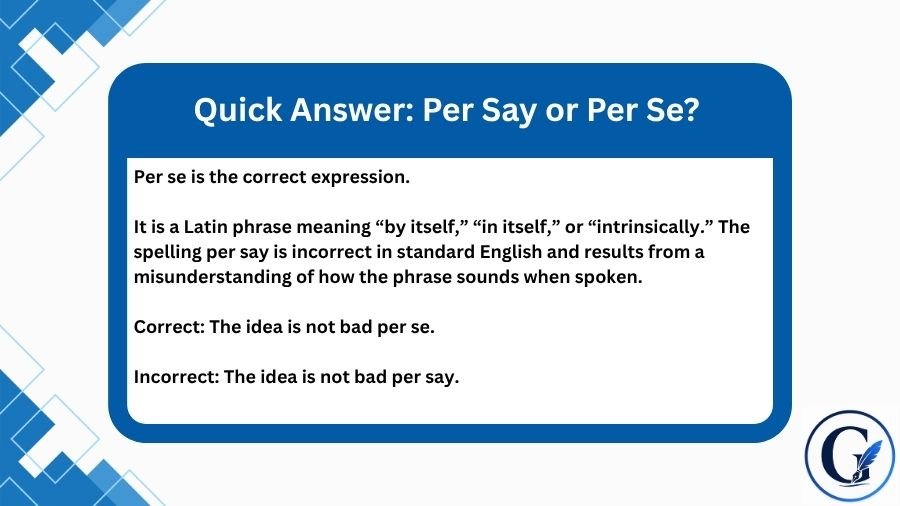
Per se is the correct expression.
It is a Latin phrase meaning “by itself,” “in itself,” or “intrinsically.” The spelling per say is incorrect in standard English and results from a misunderstanding of how the phrase sounds when spoken.
Correct: The idea is not bad per se.
Incorrect: The idea is not bad per say.
Understanding the Basics: Per Say or Per Se
The debate between per say or per se is actually very simple.
Per se is an established Latin phrase that has been adopted into English. It refers to something considered on its own merits or by its inherent nature.
Per say is simply a misspelling of the phrase.
Comparison Table
| Form | Type | Meaning | Example | Correct/Incorrect |
|---|---|---|---|---|
| Per se | Latin phrase used in English | By itself; inherently | The policy is not unfair per se. | ✅ Correct |
| Per say | Misspelling | No accepted meaning in standard English | The policy is not unfair per say. | ❌ Incorrect |
Simple Rule
If you mean “in itself” or “by itself,” always use per se.
Correct Meanings and Uses of Per Se
What Does Per Se Mean?
The phrase per se literally means:
- By itself
- In itself
- Intrinsically
- Essentially
It allows speakers and writers to separate a thing from related circumstances.
Example 1
Sentence: The technology is not dangerous per se.
Breakdown:
- Technology itself is not dangerous.
- Problems arise from how people use it.
Example 2
Sentence: Working remotely is not difficult per se.
Breakdown:
- Remote work itself is manageable.
- Certain challenges may make it harder.
Example 3
Sentence: Money is not evil per se.
Breakdown:
- Money itself is neutral.
- Human actions determine whether outcomes are good or bad.
Test Tip 💡
Replace per se with “in itself.”
If the sentence still makes sense, you’re probably using it correctly.
Example:
- The method is not flawed per se.
- The method is not flawed in itself.
Both work perfectly.
Also Read This: Substantive vs Substantial
Using Per Se in Negative Statements
Many people use per se in sentences that clarify a distinction.
Examples
- The proposal is not unrealistic per se.
- The movie is not bad per se.
- The problem is not the cost per se.
In these examples, the writer is saying the issue lies somewhere else.
Test Tip 💡
Ask yourself:
“Am I separating the thing itself from related factors?”
If yes, per se is likely appropriate.
Using Per Se in Positive Statements
Although less common, per se can appear in positive statements too.
Examples
- Leadership per se requires responsibility.
- Success per se does not guarantee happiness.
- Knowledge per se has value.
The phrase still means “in itself.”
Case Study: Workplace Communication
Imagine a manager sending this email:
Incorrect Version
“The new software isn’t problematic per say. The issue is that employees haven’t received training.”
Some readers may notice the spelling mistake and question the writer’s attention to detail.
Correct Version
“The new software isn’t problematic per se. The issue is that employees haven’t received training.”
This version communicates professionalism and grammatical accuracy. ✅
Why It Matters
The manager wants to say:
- The software itself is not the problem.
- The lack of training is the real issue.
Only per se correctly expresses that meaning.
Grammar Rules Explanation
Why Is Per Se Correct?
Per se comes from Latin and has been part of English usage for centuries.
According to authoritative dictionaries and grammar references, including Merriam-Webster, the phrase means:
By, of, or in itself.
English has borrowed many Latin expressions, such as:
- Vice versa
- Ad hoc
- Bona fide
- Per capita
- Per se
Because it is an established phrase, its spelling remains fixed.
Why Is Per Say Incorrect?
The mistake occurs because:
- The phrase is often heard before it is seen.
- “Say” sounds identical to the second syllable of “se.”
- People assume the expression contains the English verb “say.”
However, per say has no recognized meaning in standard English grammar.
Rule to Remember
- Per se = correct
- Per say = incorrect
There are no standard exceptions.
Common Mistakes Section
Why Do People Write Per Say?
Several factors contribute to this common error.
Fast Typing
People type quickly and spell words based on sound rather than meaning.
Autocorrect Issues
Some devices may not automatically recognize Latin expressions.
Lack of Knowledge
Many users learn the phrase through conversation rather than reading.
Phonetic Assumption
People naturally assume the expression includes the English word “say.”
Similar Grammar Confusions
| Incorrect Pair | Correct Distinction |
|---|---|
| Its / It’s | Possessive vs contraction |
| Your / You’re | Possessive vs “you are” |
| Their / There / They’re | Possessive, place, contraction |
| Affect / Effect | Verb vs noun |
| Then / Than | Time vs comparison |
| Per Say / Per Se | Misspelling vs correct phrase |
Test Tip 💡
When uncertain, look up the expression in a trusted dictionary. If only one version appears, that’s usually the correct form.
Usage in Different Contexts
Everyday Conversation
People frequently use per se when clarifying a point.
Examples
- Coffee isn’t unhealthy per se.
- Traveling isn’t expensive per se.
- Social media isn’t bad per se.
These statements suggest that other factors matter.
Professional Writing
Business professionals often use per se to add precision.
Examples
- The strategy is not ineffective per se.
- The budget is not the issue per se.
- The process is not flawed per se.
Professional communication benefits from this nuance.
Academic Writing
Researchers frequently use per se when discussing concepts independently.
Examples
- Intelligence per se does not guarantee success.
- Data per se cannot explain causation.
- Education per se is not the sole factor.
Academic writing values this level of precision.
Creative Writing
Authors use per se to add sophistication to dialogue and narration.
Example
“Fear wasn’t the enemy per se,” she thought. “It was uncertainty.”
The phrase helps express subtle distinctions.
Social Media and Texting
Even in casual communication, per se appears regularly.
Examples
- Not mad per se, just disappointed.
- It’s not weird per se.
- Not wrong per se lol 😂
Although social media is informal, the spelling should still be per se.
Why It Matters
Many people wonder whether this small spelling difference really matters.
The answer is yes. ✅
Clarity in Communication
Correct grammar helps readers understand your intended meaning immediately.
Professionalism
Employers, clients, professors, and colleagues notice writing accuracy.
Credibility
Proper language usage builds trust.
Better Digital Communication
Online content spreads quickly. Errors can affect how people perceive your expertise.
Quote
“Good writing is clear thinking made visible.”
Using per se correctly contributes to that clarity.
Special Exception Section
Are There Any Exceptions?
In standard English grammar, there are no accepted situations where per say is correct.
However, you may occasionally see:
- Brand names
- Usernames
- Song titles
- Social media handles
These are stylistic choices rather than grammatical usage.
Example
A company could theoretically call itself:
Per Say Media
This would be a brand name, not a grammar rule.
For normal writing and speaking, always choose per se.
Quick Recap Checklist
Decision Table
| Question | If Yes → Use |
|---|---|
| Do you mean “in itself”? | Per se |
| Do you mean “by itself”? | Per se |
| Are you writing a formal document? | Per se |
| Are you spelling the Latin phrase? | Per se |
| Are you considering “per say”? | Never use it |
Practice Examples
Example 1
The restaurant isn’t expensive _____.
✅ Answer: per se
Example 2
The technology isn’t dangerous _____.
✅ Answer: per se
Example 3
The rule isn’t unfair _____.
✅ Answer: per se
Frequently Asked Questions (FAQs)
Is per say ever correct?
No. In standard English, per say is considered a misspelling. The correct phrase is per se.
What does per se mean?
Per se means “by itself,” “in itself,” or “intrinsically.”
Why do people write per say?
People usually spell it based on pronunciation. Since per se sounds like “per say,” many assume that spelling is correct.
Is per se formal or informal?
It can be used in both formal and informal contexts. However, it appears most frequently in professional, academic, and analytical writing.
Can I replace per se with “in itself”?
Usually, yes.
Example:
- The plan isn’t bad per se.
- The plan isn’t bad in itself.
Both communicate nearly the same idea.
Is per se an English word?
Not originally. It comes from Latin but has become a standard expression in modern English.
Final Comparison: Per Say vs Per Se
| Feature | Per Say | Per Se |
|---|---|---|
| Standard English | ❌ No | ✅ Yes |
| Dictionary Recognition | ❌ No | ✅ Yes |
| Means “by itself” | ❌ No | ✅ Yes |
| Appropriate for Formal Writing | ❌ No | ✅ Yes |
| Recommended Usage | ❌ Never | ✅ Always |
Conclusion
The confusion between per say or per se is extremely common because both expressions sound alike when spoken. However, the grammar rule is straightforward: per se is the only correct form.
This Latin phrase means “by itself,” “in itself,” or “intrinsically.” It helps writers and speakers distinguish a thing from related circumstances, making communication more precise and effective. In contrast, per say is simply a phonetic misspelling with no recognized meaning in standard English.
Whenever you are tempted to write per say, remember the simple substitution test. If you can replace the phrase with “in itself,” then per se is the correct choice.
Mastering small distinctions like this improves clarity, professionalism, and confidence in your writing. ✍️ The next time you encounter per say or per se, you’ll know exactly which one belongs on the page—and why.

Hi, I’m James Anderson, an educator passionate about teaching grammar and writing skills. I aim to simplify complex topics and help learners build strong communication abilities.