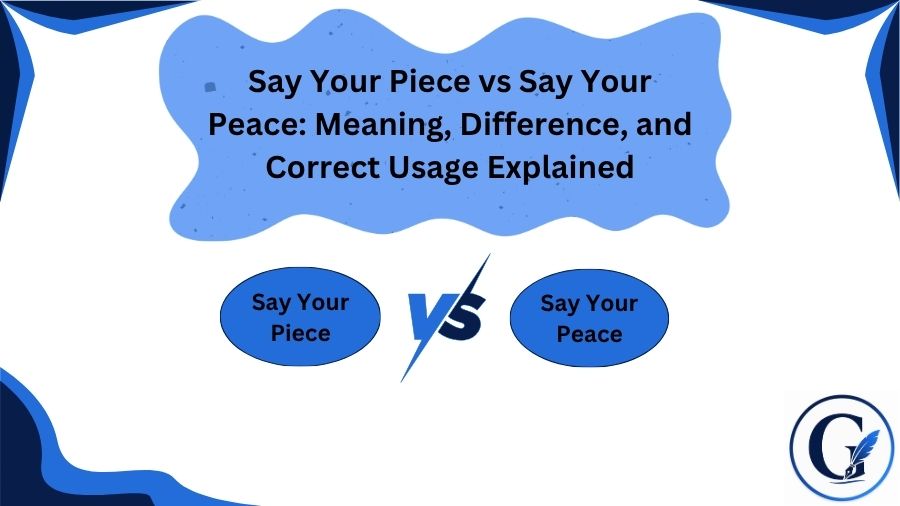
Say Your Piece vs Say Your Peace: Meaning, Difference, and Correct Usage Explained
The confusion between say your piece vs say your peace is one of the most common English grammar mistakes people make in both speech and writing. If you’ve ever heard someone say “I need to say my peace” and wondered whether it sounds correct, you’re not alone. 🤔 These two phrases sound almost identical, but only one is grammatically correct and widely accepted in standard English usage.
Many people mix them up because they are homophones—words that sound the same but have completely different meanings. This small spelling difference can completely change the meaning of a sentence, leading to confusion in conversations, workplace communication, and even online posts. In this article, we’ll clearly break down the difference between say your piece vs say your peace, explain the correct usage with examples, and help you confidently use the right phrase every time.
Quick Answer: Say Your Piece vs Say Your Peace

“Say your piece” means to express your opinion or share what you want to say, especially when you’ve been holding it in.
“Say your peace” is a common mistake and is generally incorrect in standard English usage. People confuse it with “piece,” but “peace” refers to calmness, not speaking.
👉 The correct idiom is “say your piece.”
Understanding the Basics: Say Your Piece vs Say Your Peace
To fully understand this confusion, let’s break down both phrases in simple terms.
✔️ What Does “Say Your Piece” Mean?
“Say your piece” is an English idiom that means:
- To express your opinion fully
- To speak your mind
- To share what you need to say, even if others disagree
It often implies that someone is finally getting a chance to speak or finish what they’ve been holding back.
Example:
- He let everyone argue first, then stepped in to say his piece.
👉 Here, “piece” refers to a portion of opinion or statement, not a physical object.
❌ What About “Say Your Peace”?
“Say your peace” is commonly used but not traditionally correct in standard English idioms.
Why?
- “Peace” refers to calmness, silence, or absence of conflict.
- It does not logically connect to the act of expressing an opinion.
However, people often assume it means:
- “Speak calmly”
- “Express yourself peacefully”
But in formal grammar and dictionaries (including Merriam-Webster), the correct idiom remains “say your piece.”
Also Read This: In Which vs Where
📊 Comparison Table: Say Your Piece vs Say Your Peace
| Form | Type | Meaning | Example | Correct/Incorrect |
|---|---|---|---|---|
| Say your piece | Idiom | Express your opinion or thoughts | “She finally said her piece in the meeting.” | ✅ Correct |
| Say your peace | Misused phrase | Incorrect version of the idiom | “He said his peace before leaving.” | ❌ Incorrect |
Correct Meanings & Uses
🗣️ “Say Your Piece” in Everyday Communication
This phrase is used when someone wants to:
- Share an opinion in a discussion
- Speak up after being silent
- Finish what they feel strongly about
Example breakdown:
- “She decided to say her piece during the debate.”
- She = subject
- decided to say = action
- her piece = her opinion
👉 It does not mean “a physical piece,” but rather a segment of expression.
Test Tip:
If you can replace it with “express your opinion,” then “say your piece” is correct.
😌 Why People Say “Say Your Peace” (Even If It’s Wrong)
Many people mistakenly say “say your peace” because:
- “Peace” feels emotionally appropriate in conflict situations
- It sounds more polite or calming
- It is influenced by phrases like “rest in peace”
- Speech habits reinforce the mistake over time
But grammatically, it changes the meaning completely.
Case Study: Real-Life Usage Example
Imagine a workplace meeting:
Scenario:
A team is discussing a failed project. Everyone is talking over each other.
- Manager: “Let’s go one by one so everyone can say their piece.”
- Employee A: “I think the deadline was unrealistic.”
- Employee B: “I agree, and I’d like to add something too.”
Now imagine if someone said:
- ❌ “Let’s go one by one so everyone can say their peace.”
This sounds awkward because “peace” has nothing to do with opinions or feedback in this context.
👉 Correct usage ensures clarity and professionalism in communication.
Grammar Rules Explanation
The confusion between say your piece vs say your peace is rooted in homophones—words that sound the same but have different meanings.
📚 Authority Insight
According to standard dictionaries like Merriam-Webster, the correct idiom is:
“say one’s piece: to express one’s opinion fully”
There is no recognized idiom “say one’s peace” in formal English grammar references.
Why “Piece” Works Grammatically
- “Piece” = a portion or segment
- In idiomatic English, it represents a portion of speech or opinion
Why “Peace” Does Not Work
- “Peace” = calm, silence, or harmony
- It does not represent speech or expression
Common Mistakes
⚠️ Why This Mistake Happens
People confuse these phrases because of:
- Fast typing ⌨️
- Autocorrect replacing words incorrectly
- Hearing the phrase wrong in conversation
- Lack of exposure to written idioms
📊 Similar Grammar Confusions
| Incorrect Form | Correct Form | Explanation |
|---|---|---|
| Say your peace | Say your piece | “Piece” = opinion, “peace” = calmness |
| It’s vs Its | It’s = it is / Its = possession | Apostrophe confusion |
| Your vs You’re | Your = possession / You’re = you are | Homophone error |
| Their vs There vs They’re | Different meanings | Sound identical but differ in usage |
Usage in Different Contexts
💬 Everyday Conversation
- “Go ahead, say your piece. I’m listening.”
💼 Professional Writing
- “Each team member was invited to say their piece during the review.”
✍️ Creative Writing
- “Before she left the village forever, she decided to say her piece.”
📱 Social Media/Texting
- “He finally said his piece and logged off 😤”
Why It Matters
Using the correct phrase is not just about grammar—it’s about clarity.
- Improves communication accuracy
- Enhances professional credibility
- Prevents misunderstandings
- Strengthens writing confidence
“Clear language creates clear understanding.”
In both personal and professional communication, small language details can make a big difference.
Special Exception Section
While “say your peace” is not standard English, you may occasionally see it:
- In informal writing
- As a deliberate stylistic choice in poetry or storytelling
- In casual speech where grammar rules are relaxed
However, even in these cases, it is still considered non-standard.
Quick Recap Checklist
| Question | If Yes → Use |
|---|---|
| Are you expressing an opinion? | Say your piece |
| Are you referring to calm or silence? | Not applicable idiomatically |
| Is it formal writing? | Say your piece |
Practice Examples
- “Before we close the meeting, I want to ___.”
- ✅ say my piece
- “She waited her turn to ___ during the discussion.”
- ✅ say her piece
- “He said his ___ and walked away.”
- ❌ peace (incorrect usage)
FAQs
1. What does “say your piece” mean?
It means to express your opinion or share your thoughts fully, especially in a discussion.
2. Is “say your peace” ever correct?
No, it is generally considered incorrect in standard English, though it is commonly misused.
3. Why do people confuse piece and peace?
Because they are homophones—they sound the same but have different meanings and spellings.
4. Can I use “say your piece” in formal writing?
Yes, it is grammatically correct and widely accepted in both formal and informal contexts.
5. What is a simple way to remember the difference?
Think: piece = opinion, peace = calm. Only opinions are being spoken, so use “piece.”
6. Is this mistake common among native speakers?
Yes, even native speakers often mix them up in casual speech and texting.
Conclusion
The confusion between say your piece vs say your peace is a perfect example of how English pronunciation can mislead meaning. While both phrases sound identical, only “say your piece” is correct when referring to expressing thoughts or opinions.
“Say your piece” comes from the idea of sharing a piece of your mind, while “peace” relates to calmness and has no connection to speech or expression. Understanding this difference helps improve clarity, accuracy, and confidence in communication.
So the next time you want to speak your mind, remember: you’re not “saying your peace”—you’re saying your piece. And that small difference can make your English sound significantly more polished and precise. ✨

Hi, I’m Sarah Williams, a content writer who loves creating simple and clear educational articles. My goal is to help learners improve their grammar and writing confidence.